

If Talent Is Everywhere, Why Isn't Prosperity?
October 27, 2026
Economic most valuable resource is in people’s minds.
When governments talk about diversifying their economies, the conversation usually turns to ports, logistics, tourism, fintech. Creativity rarely makes the slide deck. When it does, it appears near the end, filed under "culture," as if it were something a country spends money on once the serious work is done.
That framing is wrong, and the numbers show it.
This is a sector bigger than most people think, According to UNESCO, culture and creativity account for 3.1% of global GDP and 6.2% of employment. That is not a niche. That is an employer on the scale of entire national industries, and it is one that rarely appears in economic planning with the weight it deserves.
Trade data makes the case even more strongly. UNCTAD estimates that global exports of creative services hit a record $1.7 trillion in 2024, more than double the $709 billion in creative goods exports. Creative services now make up about 20% of all trade in services, while creative goods account for roughly 3% of merchandise trade.
The most important part of that data is the direction. Between 2010 and 2024, creative goods exports grew only modestly, while creative services exports more than doubled.
The lesson for any country is uncomfortable. Exporting crafted objects is no longer where most of the value sits. The value is in design, software, content, intellectual property, research. A country that makes beautiful things but does not own the ideas behind them captures a shrinking share of what its creativity is worth. In brief, The value has moved from the object to the idea.
Creativity does not automatically turn into national wealth. Talent is everywhere. Structures that convert talent into exports are not. Creativity is very important, but, so far, its rewards are not distributed equally.
Creativity is not only a sector, it is also a workforce skill. This is not only about artists, photographers, designers and filmmakers. In the World Economic Forum's Future of Jobs Report 2025, creative thinking was named a core skill by 57% of the more than 1,000 employers surveyed. The WEF also expects technology driven job changes to raise demand for creative thinking along with resilience and agility.
As automation makes routine work cheaper, original thinking becomes scarcer and more valuable. A country that teaches its people to follow instructions is preparing them for jobs that are disappearing.
Governments are taking this seriously setting hard targets. Dubai is a clear example. Its Creative Economy Strategy, launched in 2021, set out to raise the creative industries' share of GDP from 2.6% in 2020 to 5% by 2026, and to nearly double the number of creative companies from 8,300 to 15,000 and the number of creative jobs from 70,000 to 140,000. It backed this with practical tools, including a 10 year visa designed to attract creators, writers and artists.
Governments do not set numerical GDP targets for hobbies. They set them for industries they expect to carry the economy.
In my work with creatives across the UAE, Lebanon and the middle east, I see the same pattern repeatedly. Countries treat creative people as artists to be celebrated or subsidised, rather than as founders to be equipped. The talent is real. The business skills, the pricing, the contracts, the IP protection, the route to export: that is where value leaks out, this is what most countries still get wrong.
The UAE Is Betting on Creativity as Economic Infrastructure. The Rest of the Region Should Pay Attention. For decades, the standard Gulf diversification story was about ports, aviation, real estate and finance. Creativity was something you funded once the economy was built, a cultural amenity rather than an economic engine.
The UAE has decided that framing is outdated. And it has put strategy, targets and serious money behind that decision, the UAE is clearly trying to land on the producer side of that line. Few countries in the region have moved with this level of coordination.
Strategies, buildings and visas attract talent. They do not automatically turn that talent into sustainable businesses.
In my work with creatives across the UAE and Lebanon, the gap I see most often is not talent and it is not infrastructure. It is business capability. Gifted designers, photographers, filmmakers and artists who cannot price their work, protect their IP, negotiate a contract or build a model that survives beyond the next project. Every one of those failures is economic value leaking out of the system.
Licences can be issued in minutes. Entrepreneurial skill takes years. If the UAE wants its creative sector to reach 5% of GDP and stay there, the next phase has to focus less on attracting creatives and more on equipping them to build companies that scale and export, and I believe they are on the right path.
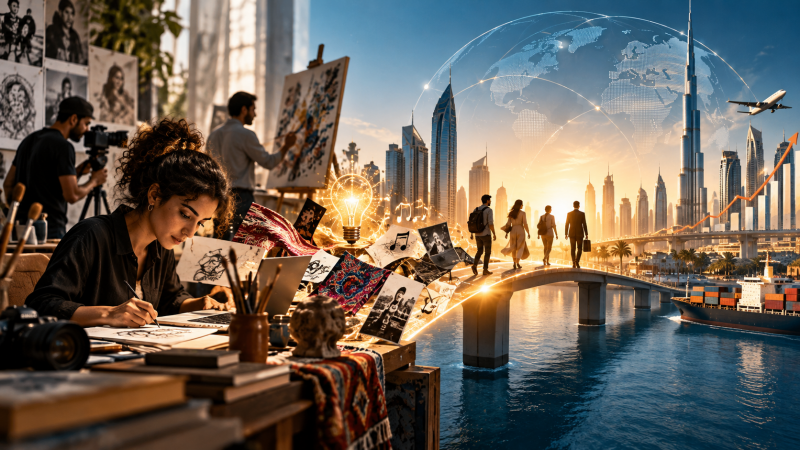
A country's creative economy is only as strong as the bridge between talent and enterprise. Build that bridge, and creativity becomes one of the most resilient, exportable and future proof assets a nation can have. Ignore it, and you end up importing the culture your own people could have produced.
Either we like it or not, the value is shifting from objects to ideas: design, software, media, content, intellectual property. For an economy trying to move beyond hydrocarbons, that shift is an opportunity that is hard to ignore.
So the real question for policymakers is not whether creativity matters economically. That is settled. The question is whether we are building the systems that let our creatives get paid for it.
What do you think is the biggest barrier in your country?
Sources
UNCTAD, Creative Economy Outlook 2024 and UNCTADstat creative economy data (unctadstat.unctad.org)
UNESCO, Re|shaping Policies for Creativity: Addressing Culture as a Global Public Good, 2022
World Economic Forum, Future of Jobs Report 2025
World Governments Summit, report on the creative economy as a driver of growth (via WAM)
UAE Government Portal, National Strategy for the Cultural and Creative Industries (u.ae)
WAM and Gulf Today coverage of the national strategy launch, 2021
Dubai Creative Economy Strategy, via Gulf News and WAM
Department of Culture and Tourism Abu Dhabi, CCI investment strategy, via Gulf News and twofour54
UNESCO, Re|shaping Policies for Creativity, 2022
World Governments Summit, creative economy report, via WAM
Souheil Semaan